Almoçageme Collective Housing - Almoçageme - Sintra - Housing
Following the urban typologies in presence, a proposal of 3 housing units is presented, all with independent and direct entrances from the gardened exterior space.
House N1
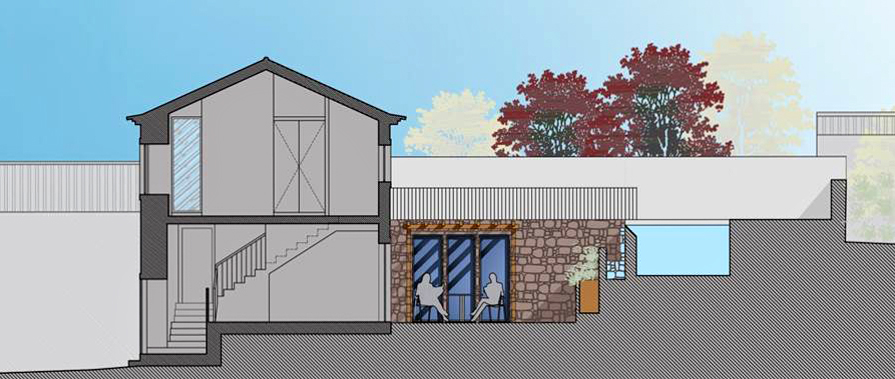
House 1, which corresponds to a 2 bedroom typology, replaces Ruin 1, moving its implantation slightly to the east and leaning against the extreme of the land, thus allowing greater fluidity in access to the remaining spaces of the plot.
The house has 2 floors and 2 suites located on the first floor, and a living room with kitchen and toilet on the upper floor. This house corresponds to a tower house, thus assuming a direct influence of Islamic architecture in the design. As in traditional architecture in the "towered typology" the dining room appears on the upper floor.
House N2
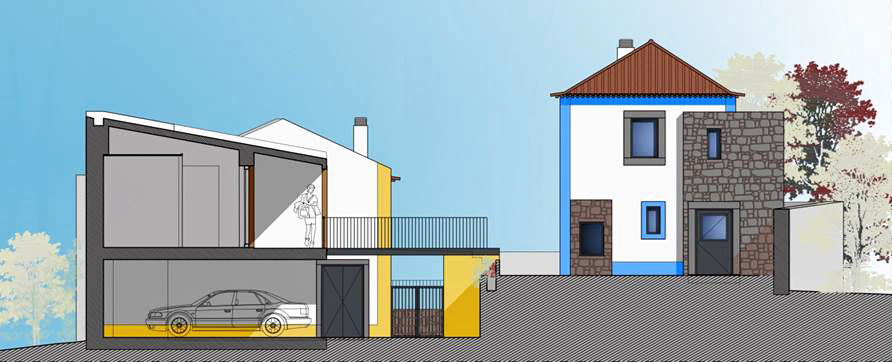
In its ground level House 2 contains covered private parking spaces and a room for common use to the 3 housing units to allow a common work space in the housing place. On the upper floor there is a 3 bedroom apartment, with 3 suites and a living room. The access to this unit is made through a small bridge that connects to a covered porch, of traditional/vernacular design.
House N3
The House 3, which corresponds to a typology T1, is located in the place of Ruin 3, and is composed on the first floor, by a living room, kitchen, and respective sanitary installation of support. On the upper floor contains a suite.
In front of House 1, is located the third parking space, private and uncovered.
Elevations
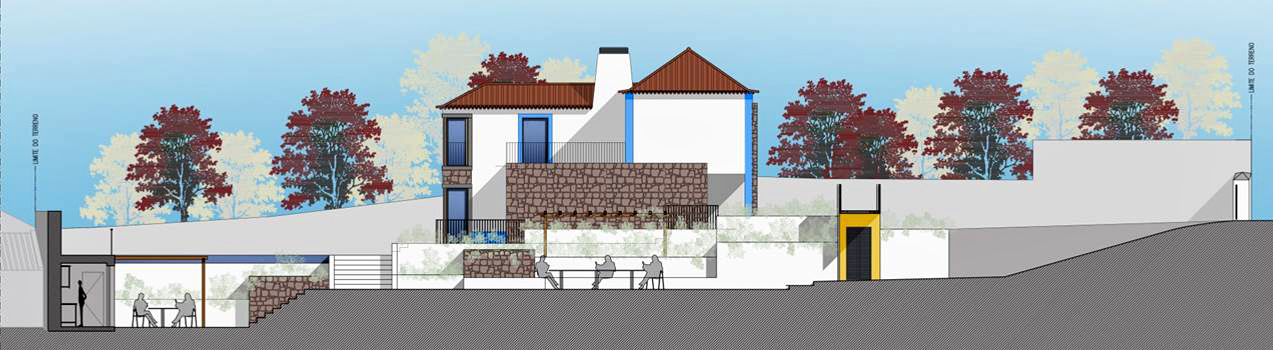
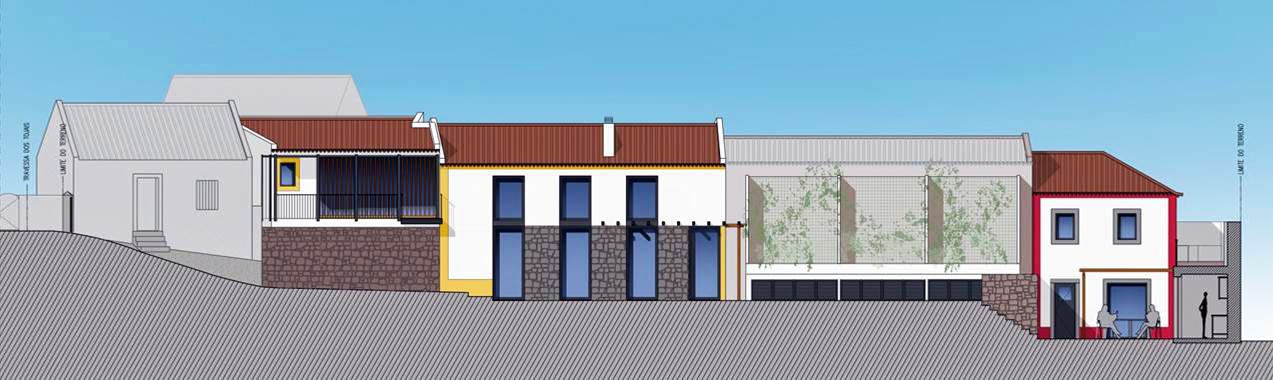
The design of the elevations in the three houses is inspired by the vernacular architecture of the region. The elevations present the traditional alternation of full and empty spaces in which the vertical spans alternate with the full panels of the masonry. All stone elements that can be used will be reused.
However, at several moments the proportion of the spans, as well as the location of covered outdoor areas, point to a clearly contemporary design. The stone, in addition to frame the openings as is traditional in “Saloia” architecture is introduced sparingly in small details in each of the three houses in a clearly contemporary attitude.
The composition of this nucleus intends to return, in some extend, to the architectural philosophy of the region. For example, it contemplates a construction of a "Towered" house. The differential of the different levels allows the "tower" construction to be emphasized, since the tower construction is implanted on the highest datum levels of the terrain.
Um enorme plano de verde vertical permite ocultar a vista da construção cor-de-rosa adjacente (Fotografia 8), que apresenta um alçado sem qualidade de desenho. Note-se que as aberturas não estão licenciadas e são compostas por frestas pelo que não carecem de afastamento de construções adjacentes.
Chromatic Composition
As in the vernacular architecture of this region, the color is used in the clasps and in the corners, leaving the stone for the window frames. The buildings were individualized based on the use of color. The two most frequent colors in the region's architecture - iron oxide and blue - were used, but also ocher, a color widely used in the vernacular architecture of the south and center of the country.
A huge plane of vertical green hides the view of the adjacent pink building which presents a vertical elevation with no design quality.
This vertical plan is constituted at its base by cabinets where it is foreseen the placement of the air conditioning units that are topped by flower boxes.